
Quarry #2: Having Eyes

Or, query.
To begin with nothing in mind. O I’ve written and rewritten that damn preceding sentence at least ten times, probably more, with the hope that through mere repetition something will, indeed, come to my mind, something to eradicate the menace of white space, but all that has occurred to me is this present, rather empty, commentary on the preceding sentence, which sentence I must now leave in place if I am to have any chance at moving on with my life and putting down some sentences for you to read or not at your leisure. Alas!
More, mere, my, mind, menace, me, must, moving. “Move out of yourself,” I say to myself.
Well, I can tell you that I keep several things on my desk. Five scrabble letters (one mysteriously missing). A terracotta bowl of sea shells. A paper weight made of blue glass that I never employ. A fossil, shaped like a bullet or an uncut cigar, called a belemnite: the remains of the internal shell or “guard” or “scabbard” of a mollusk, possibly some 250 million years old (gulp). Postcards of: a Bernini statue, two Turner paintings, and a Blake print. And three copper tokens known as “tallies” that were used around the turn of the last century for the wholesale exchange of fruits and vegetables at Spitalfields Market in London. These last objects I keep in the little red box they came in (a gift). I suppose I keep this small collection of objects near at hand for its familiarity and comfort and because it helps me to think when nothing comes to mind.
For me it is an enduring source of enchantment that physical objects have the power to operate on me, to spark a series of thoughts or images that sometimes compel me to write. In the case of the above objects, I have the thrilling option of treating them not merely as artifacts qua artifacts, confined as they normally would be to their natural or cultural status, but as portals that grant me access to an abstract plane on which I can begin to prospect a higher order of associations. External objects can generate mind-content, if you allow them to. The longer I contemplate an object, the more I am inclined to accept some version of panpsychism, to believe there exists a conduit of consciousness between me and the object of my gaze.
I’d like to call this magic: I began with nothing in my mind, but now, as I write, a series of affinities, impulses, constellations begin to appear. For example, what grips me at this very moment is the fact that these four Scrabble letters were, by chance, arranged to spell: E1 N1 A1 N1. I say by chance, because I have no recollection of making this order. Nor did I know what the word means. Only now have I bothered to see if it is, in fact, a word, and it is. It is the Hebrew name of the father of a man named Ahira, who, in the Book of Numbers, was one of the tribal leaders tasked with guiding the Israelites through their 40 years of wandering in the wilderness. It means “having fountains” or “having eyes.”
Ex nihilo, something comes forth, something escapes. A brief Internet excursion I took moments ago turned up the following relations. Enan. From the noun עין, ‘ayin. Meaning: eye, fountain. In Kabbalistic thought, Ayin is also the (non-)concept of “nothingness” from which the universe is created: Yesh me-ayin. Something from nothing.
Over the past couple of weeks, before going to sleep, before my eyes droop to a close for the night, I’ve been enjoying snatches of Elias Canetti’s memoir of his time in Vienna between 1931 and 1937 (prior to his escape to England) and his encounters with Hermann Broch, Anna Mahler, Franz Wotruba, and Robert Musil, among other personages. The book was published in Germany by Verlag in 1985 with the title Das Augenspiel. The US edition, published by Farrar, Straus & Giroux in 1986, carries the title: The Play of the Eyes.
Across his impressions of these artists and writers, Canetti reminds me that memories first locate themselves in the slightest of details, before radiating out into fuller portraits. He is constantly returning to: Broch’s “naked” breath (“the main sense through which [he] apprehended the world”); or to Wotruba’s “stone” hands (“creatures in their own right with a language of their own”). But, thus far, I have been most taken by his reflections on Anna Mahler, with whom he had a brief flame, to whose eyes he was drawn, by whose eyes he was brought into something sublime:
How was I to acknowledge a reality so prodigious: that eyes can be more spacious than the person they belong to? In their depth there is room for everything one has ever thought, and since there is room for it, it all demands to be said.
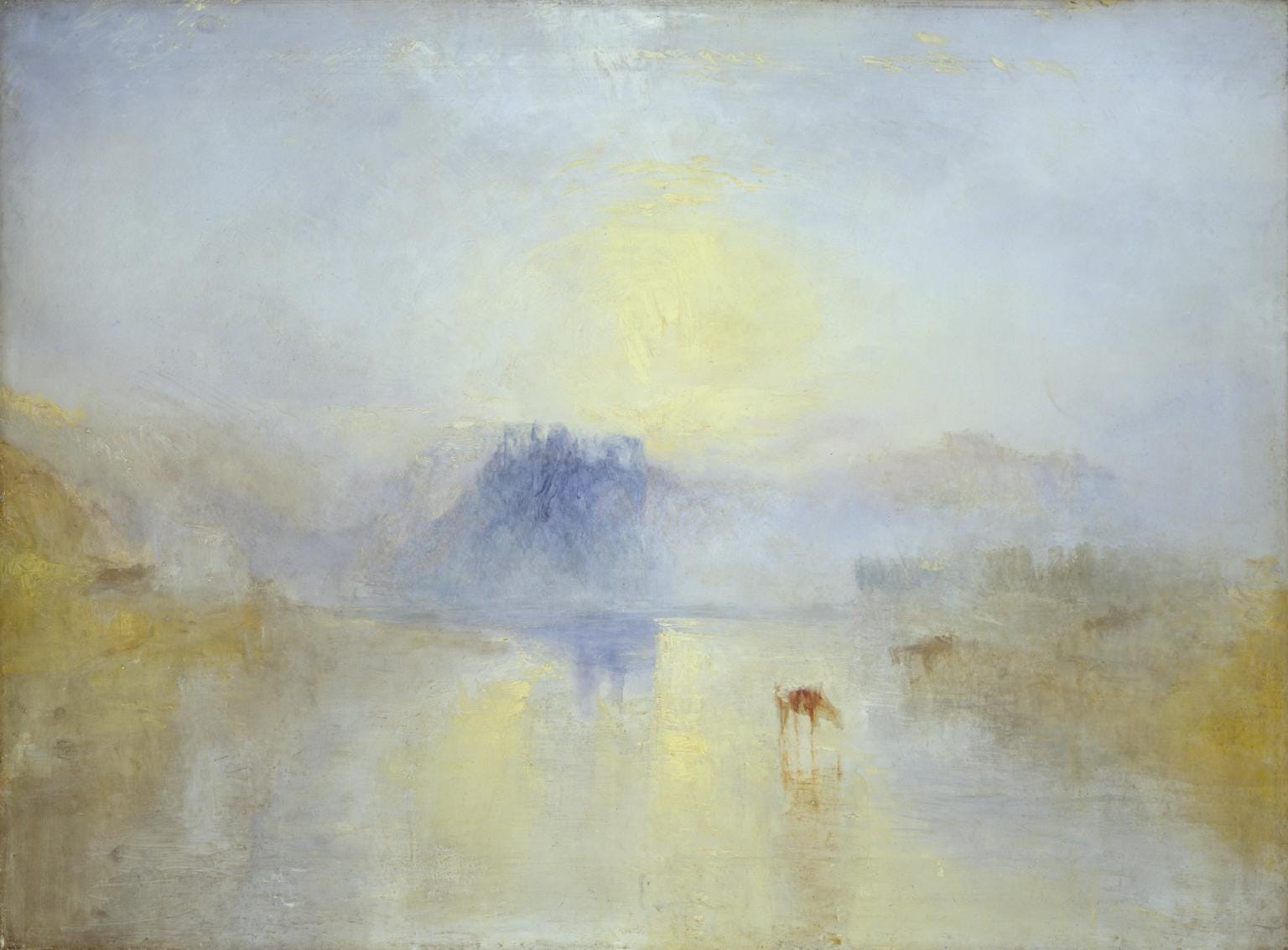
Norham Castle, Sunrise. Oil on canvas, 35.7 in x 48.0 in. By J. M. W. Turner, c. 1848.
Glad you found an inspired line of thought. I really liked this essay a lot, the linguistics, then Vienna, and the deep eyes. Beautiful metaphor for the act of truly thinking (in my opinion) which is so strenuous to me sometimes. So I read. Two books came to mind. My Fathers Paradise, by Ariel Samar about his father trying to preserve neo Aramaic, and Anima Rising, Christopher Moore’s romp in 1911 Vienna with fine tuned characterizations of Klimt, Schiele, even Anna Mahler was in there!